Montessori teacher education
VMTEC has been committed to the principles and philosophy of Maria Montessori since 2006 — offering preparation that is flexible, affordable, rigorous, and authentic for teachers who serve the needs of the child.
Next cohort begins June 2027.
Early Childhood Curriculum
Our Early Childhood program runs 12 months in a blended format built for working adults: one distance-learning week, six weeks of face-to-face summer instruction, practice sessions three times a month through the year, and a 540-hour internship at an approved Montessori school.
-
This blended course covers Montessori’s historical and philosophical foundations and their view of human development—physical, intellectual, emotional, social, spiritual. Topics: history and evolution of the method, cosmic education, curriculum theory, classroom management, child development, the prepared environment, and teacher preparation.
87.5 clock hours
-
Practical Life is presented as the foundation for all curriculum areas. The course covers Preliminary Exercises, Control of Movement, Care of the Environment, Care of the Self, Grace and Courtesy, and Food Preparation. These activities teach children their role in the environment, how physical order supports mental organization, respect for others, and self- and environmental care. Through purposeful tasks, children develop grace and courtesy, motor control, concentration, self-confidence, and independence.
37.5 clock hours
-
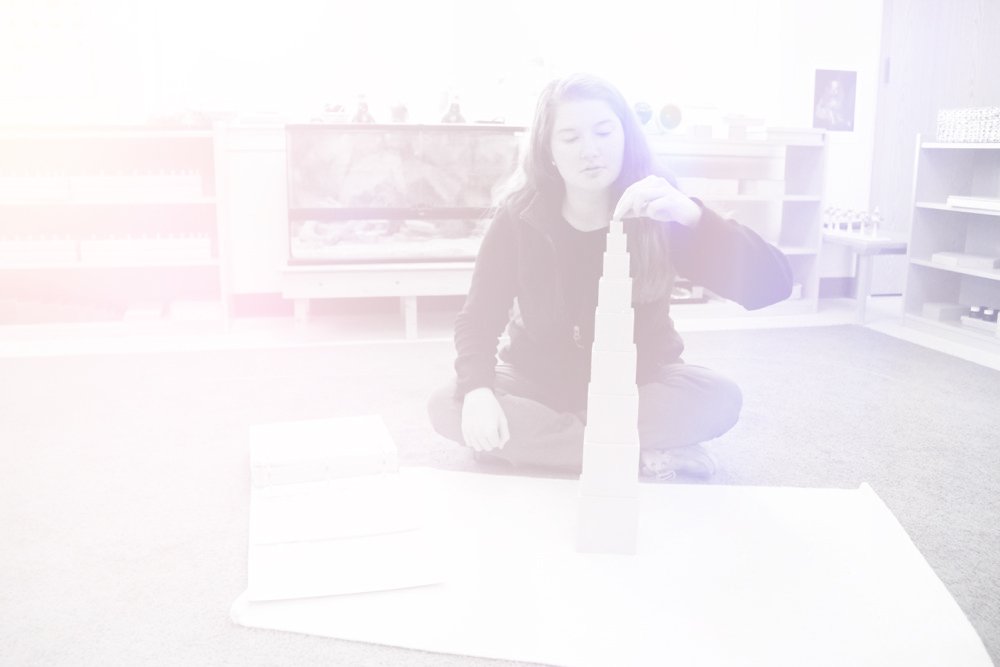
Sensorial theory underpins intellectual education. Students will learn Montessori’s differentiated instruction by refining the senses with Sensorial materials. Through visual, tactile/muscular, olfactory, gustatory and auditory exploration using concrete materials, children access the absorbent mind. Students will translate a child’s learning sensitivities into practical uses of Montessori materials and apply a multi-sensory approach to support all learning styles. They will design and implement multi-sensory curricula; classification and organization of experiences help children internalize concepts and develop the mathematical mind.
37.5 clock hours
-
Receptive and expressive language development covers visual/auditory discrimination, vocabulary, oral language, reading, writing, grammar, penmanship, creative writing, research, and multicultural studies. Language pervades the curriculum and classroom social life. Students learn sensitivity to language and the need for environments that foster language growth and listening skills.
37.5 clock hours
-
This course delivers a concise, thorough math curriculum and explains development of mathematical thinking. Arithmetic, fractions, geometry, and algebra are taught as sensory-based "materialized abstractions" that guide children to abstraction. Topics include counting (including decimal, linear, and skip counting), fact memorization, transition materials for elementary, plus supplemental concepts: fractions, measurement, money, and time.
37.5 clock hours
-
This course presents the study of geography and science for the child age 3-6. The foundation is laid for an understanding of world geography and different cultures through work with water and land forms, puzzle maps, flags and geography folders. The student will learn the fundamentals of zoology, botany, and physical science both in the classroom and outdoors. Observation of scientific phenomena through simple experiments using the child’s intrinsic interest will be presented. A study of time using calendars, the clock, and personal time lines enhances the child’s awareness of the passing of time.
30 clock hours
-
Art is presented as exploration of media and a means to self-expression with an emphasis on variety. The process of an art activity rather than the product is emphasized. A cultural and historical component is included. Peace, as an essential element of a Montessori classroom, is taught through role-playing, art, meditation and various other activities and routines.
22.5 clock hours
-
The study of early childhood music and movement is presented as developmental process of absorption, exploration, and self-expression, with an emphasis on various present and historical cultures. Physical Education is presented as Movement, which may include the development of the body through exploration, cooperative play, rhythms and dance.
22.5 clock hours
-
This intensive course will focus on five areas of management in the Montessori classroom. These areas are Managing the Environment, Managing the Work, Managing Planning and Records, Managing Time, and Managing Behavior. As a part of Managing Planning and Records, particular emphasis will be placed on developing Montessori curriculum and Montessori oriented lesson plans, lesson giving schedules, follow-up records, and student notebooks.
7.5 clock hours
-
Attendance is required at a supervised weekly practicum seminar with materials, including spontaneous problem solving and support sessions bi-weekly throughout the school year. Practicum seminar will include utilizing Montessori materials and problem solving sessions. One session will be face-to-face, the other session will be held on Zoom. Out of town students must connect on Zoom for all sessions.
42.5 clock hours
Interested in
training with us?
Let us know you’re interested and we’ll get you started with an application.